

Single-origin New Zealand
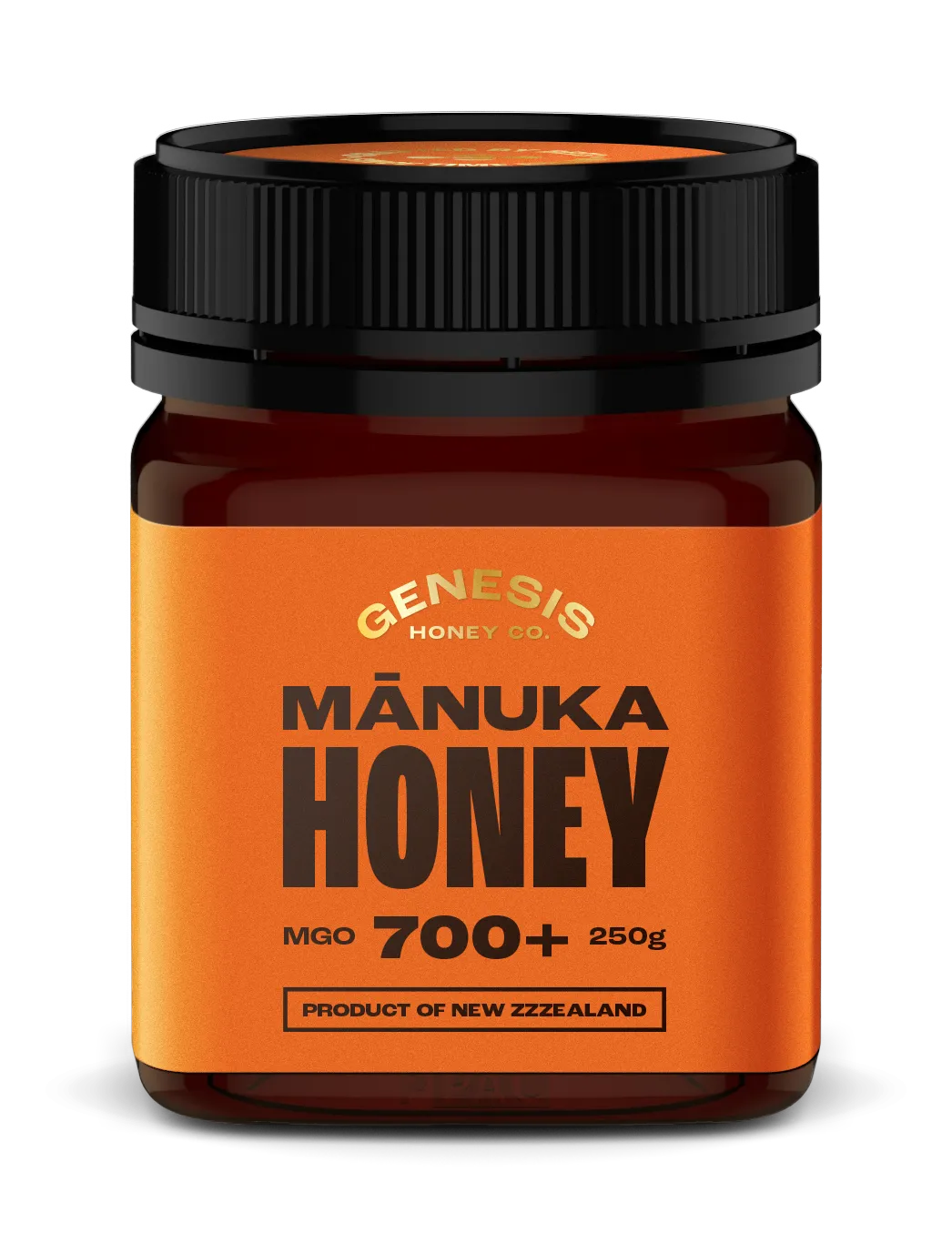
MGO 700+ Mānuka Honey 250g
Dark, thick and almost caramel — mānuka tastes nothing like the clover honey in the supermarket aisle. This is one harvest from one stretch of New Zealand hill country, where mānuka flowers for four to six weeks a year and then stops.
Graded MGO 700+ — and the jar in your hand traces to its own laboratory certificate, not to a claim on a label.
Roughly 35 teaspoons — about $2.83 each
Add to cart — $99 AUD- Free shipping to every state and territory except Western Australia — the price you see is the price you pay
- Dispatched within 2 business days, tracked
- 30-day returns on unopened jars
- Secure checkout by Stripe
- We cannot ship to Western Australia — quarantine rules restrict honey entering the state. Order to one and we refund in full.
Sold by Genesis Honey Co Pty Ltd (Australia), Homebush West NSW. Packed in New Zealand by Genesis Honey Co Ltd, Mount Maunganui, New Zealand. Questions? Talk to us.
Look up this batch — ghc-2504-jm-d7b2-816 →MPI export certified
Exporter ID AEX000242
RMP-registered packing
Risk Management Programme, New Zealand
Independently tested
Hill Laboratories, New Zealand
Product of New Zealand
Single-origin, never blended
The grade
MGO 700+
methylglyoxal, milligrams per kilogram
MGO is what separates mānuka from every other honey, and the number is the floor, not the headline — we label the tier a batch clears and round down, never up. Most mānuka on a supermarket shelf sits between MGO 30 and MGO 250. Above 500 the honey stops being a grocery item; a single hive yields a few kilos of it in a good year, and not every year is good.
Confirmed by Hill Laboratories, an IANZ-accredited New Zealand lab, on a sample drawn from this batch — not from a different one, and not from the producer's own bench.
What you are actually paying for
Most mānuka on an Australian shelf is blended from many sites and many seasons, graded once, and sold on the number printed on the front. Here is what is different about this jar.
Every row above is checkable. Start with the code on this jar: ghc-2504-jm-d7b2-816.
Where MGO 700+ sits
MGO is methylglyoxal in milligrams per kilogram, and the grade is a minimum rather than an average. The steps are not evenly spaced: each one up is harder to find than the last.
| Grade | Where it sits |
|---|---|
| MGO 83+ | Entry grade — everyday table honey |
| MGO 263+ | Mid grade — common on supermarket shelves |
| MGO 514+ | High grade — a specialist purchase |
| MGO 700+this jar | Premium tier — a few kilos per hive in a good year |
| MGO 829+ | Rarest harvests |
Product details
- Grade
- MGO 700+
- Grade
- MGO 700+
- Laboratory
- Hill Laboratories, New Zealand
- Size
- 250g
- Jar
- Amber glass jar, black lid
- Origin
- Bay of Plenty, New Zealand
- Harvest
- Packed
- June 2025
- Best before
- June 2030
- Ingredients
- 100% Mānuka honey. Nothing added.
- GTIN
- 9413000113167
- Packed by
- Genesis Honey Co Ltd, Mount Maunganui, New Zealand
- Sold in Australia by
- Genesis Honey Co Pty Ltd (Australia)
What customers say
It really tasted like authentic real New Zealand mānuka. I am extremely happy with the product. Packaging was great and delivery was fast. It's worth the price. I am very happy with my purchase. Thank you.
I really liked this Honey compared to other honeys I have tasted. Very healthy and good for you. Very good product. I recommend Genesis Honey. Thank you.
Really happy with this Manuka honey. I purchased it mainly for its health and wellness benefits, and I was very pleased with the quality. It arrived well packaged and in perfect condition. I would definitely purchase it again.
Bought a jar? Leave a review — we publish them as they are written.
Bought a jar?
Tell us what you thought — good or not. We publish reviews as they are written, and we never offer anything in exchange for one.
Write a reviewQuestions
What does MGO 700+ actually mean?
MGO is methylglyoxal, a compound that occurs naturally in Mānuka honey, stated in milligrams per kilogram. MGO 700+ means a laboratory confirmed at least 700mg/kg in this batch. It is a concentration, measured — not a descriptor chosen by us.
Why does the jar say 700+ rather than a higher number?
We label the grade tier a batch clears, never a peak figure. Every jar is graded on its own laboratory result, and the batch page linked above traces yours.
Is this UMF certified?
No. UMF is a separate licensing programme run by the UMF Honey Association, and we are not licensed under it, so we do not put a UMF number on our honey. We grade on MGO — methylglyoxal measured directly by an accredited laboratory — and publish the certificate for the batch you are holding. Anyone quoting a UMF equivalent without a licence is converting a number they were not given.
Is it raw?
"Raw" has no single legal definition in most markets, so we describe what we actually do instead: the honey is extracted, coarsely strained and packed without pasteurisation, under an RMP-registered process.
Why has it crystallised?
Honey crystallises naturally, faster in cooler weather. It is not a fault and nothing has gone wrong. Stand the jar in warm water — around 40–60°C — and it will loosen.
How should I store it?
Somewhere cool and dark with the lid on, and use a dry spoon every time. Moisture is the one thing that genuinely shortens honey’s life. It does not need refrigerating.
How long does a jar last?
About 35 teaspoons at roughly 7g each, so six to eight weeks at a teaspoon a day. Best before June 2030.
How do I check my jar is what it says?
Type the batch code printed on your jar into the trace page. You get that batch’s harvest window, origin region, packing date and laboratory result — the actual record, not a general statement about our honey.
MGO 700+ Mānuka Honey · 250g
AUD $99 · 30-day returns