
The Ultimate Guide to Mānuka Honey 700+ MGO: Grading, Uses & Buying Tips
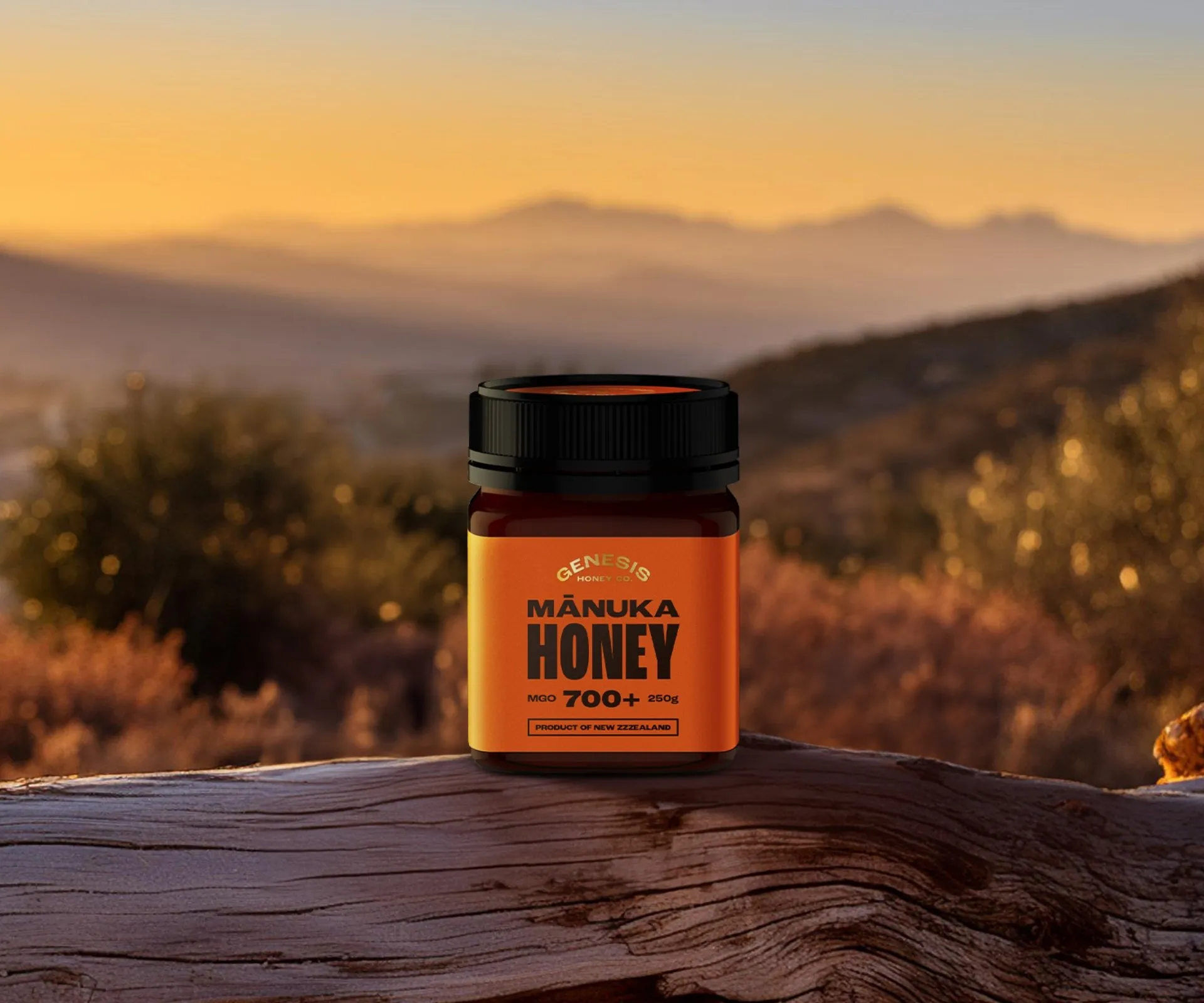
Mānuka honey is the most heavily graded, most tested and most counterfeited honey in the world. It is also sold with more confusing terminology than almost any other food product — MGO, UMF, KFactor, NPA, “active”, “bioactive”, “multifloral”, “monofloral”. A shopper trying to compare two jars is often comparing two different systems.
This guide covers what the numbers mean, how the grading actually works, how to tell genuine from questionable, and what to look for before paying a premium.
What Mānuka honey actually is
Mānuka honey is made by bees foraging the flowers of Leptospermum scoparium — the mānuka tree, native to New Zealand. That is the whole definition. It is not a process or a blend; it is a honey defined by its floral source.
The tree flowers for roughly four to six weeks a year, frequently in remote hill country, and only when the weather cooperates. That narrow window is the origin of everything else — the scarcity, the price, and the industry built around verifying it.
MGO: the number that matters most
MGO stands for methylglyoxal, a compound found in Mānuka honey at concentrations far above ordinary honey.
Mānuka nectar is unusually rich in dihydroxyacetone (DHA). As the honey matures, DHA gradually converts into methylglyoxal. That conversion happens naturally and slowly in the jar — it cannot be added, accelerated or manufactured.
An MGO grade states concentration in milligrams per kilogram. MGO 700+ means laboratory testing confirmed at least 700mg of methylglyoxal per kilogram of that honey. It is a measurement, not a marketing descriptor.
The grading scale
- MGO 83+ — entry grade, everyday table honey
- MGO 263+ — mid grade
- MGO 514+ — high grade
- MGO 700+ — premium tier
- MGO 829+ — rarest harvests
The critical thing to understand is that the scale is not linear in scarcity. Plenty of genuine harvests land in the low hundreds. Very few reach 700 or beyond, because methylglyoxal levels depend on the DHA concentration in the nectar, which varies enormously between stands, regions and seasons. Each step up the scale represents a progressively smaller share of the total harvest — which is why the price climbs faster than the number.
MGO vs UMF vs everything else
MGO measures methylglyoxal directly, in mg/kg. Simple, specific, easy to compare between brands.
UMF (Unique Manuka Factor) is a licensing system that measures MGO alongside other authenticity markers — leptosperin and DHA — and grades the honey on a combined scale. Approximate equivalents: UMF 5+ ≈ MGO 83+, UMF 10+ ≈ MGO 263+, UMF 15+ ≈ MGO 514+, UMF 18+ ≈ MGO 700+, UMF 20+ ≈ MGO 829+.
We are not a UMF licensee, so you will not find a UMF grade on a Genesis Honey Co jar. We grade on MGO and publish the laboratory certificate for each batch instead.
KFactor is a brand-specific system focused on pollen content and purity rather than methylglyoxal. It is not directly comparable to either of the above.
“Active” or “bioactive” with no number attached is not a grading system at all. Treat an unnumbered claim as no claim.
Monofloral vs multifloral
New Zealand’s Ministry for Primary Industries defines mānuka honey scientifically, using a combination of four chemical markers plus a DNA test for mānuka pollen. Honey is classified as monofloral (predominantly mānuka) or multifloral (mānuka mixed with other floral sources).
All honey exported from New Zealand as mānuka must pass this test. It is the strongest single guarantee of authenticity in the category — and it is why the country of packing matters.
How to spot a jar worth buying
Look for a specific number. “Active Mānuka” or “Premium Mānuka” without an MGO or UMF figure tells you nothing measurable.
Check where it was packed, not just harvested. Honey packed outside New Zealand has not necessarily been through MPI’s testing regime.
Ask who did the testing. A grade is only as credible as the laboratory behind it. An independent, accredited laboratory should be named — Hill Laboratories and Analytica Laboratories are two that New Zealand producers commonly use. A producer who will not say who tested the honey has told you something.
Look for batch traceability. This is the strongest signal of all. If a producer can show you the harvest, origin and laboratory result for the specific jar in your hand, the number on the front is verifiable. If they cannot, it is an assertion.
Be suspicious of volume. Global sales of “mānuka honey” have long exceeded what New Zealand actually produces. Very cheap high-grade honey is the clearest warning sign there is.
Single-origin vs blended
Most branded honey is blended — batches from different sites and seasons combined to hit a consistent target number. It is legal, common and produces a label that is technically accurate.
Single-origin honey comes from one region in one season and is graded on its own result. It varies slightly year to year, the way an honest natural product should, and it has to reach the grade unaided. Genesis Honey Co is single-origin and never blended.
Rounding: a small tell
Compare a producer’s grade to what their laboratory actually found. Ours is labelled MGO 700+ — the tier the batch clears, with headroom rather than a peak figure on the front.
The alternative is to label as close to the tested figure as possible. Both are legal. Only one is conservative.
Storing it
A cool, dry cupboard with the lid sealed. Do not refrigerate — cold accelerates crystallisation. Honey’s low moisture content means it does not spoil like perishable food; ours carries a best-before five years from packing.
Use a dry spoon every time. Moisture is the one thing that genuinely shortens honey’s life.
If it crystallises, nothing is wrong — it is a normal property of raw honey. Stand the jar in warm water for ten minutes and stir. Avoid the microwave, which heats unevenly and cooks the honey at the edges.
Using it
The golden rule is warm, never boiling. Honey’s aroma compounds are volatile; at full boiling temperature you lose most of the character you paid for. Let a cup stand a minute or two off the boil before stirring honey through.
Beyond the spoon: warm water with lemon, black tea, porridge added off the heat, sourdough with good butter, thick yoghurt with toasted nuts, whisked into a dressing with olive oil and vinegar, or as a glaze brushed on in the last few minutes of roasting.
MGO 700+ is more assertive than an everyday honey — thicker, more resinous, with a faint bitterness. Use rather less than you would of something milder.
Is the premium worth it?
That depends entirely on what you want from it. What you are paying for at the top of the scale is scarcity and verification: a narrow flowering window, a harvest that reached a threshold most do not, independent laboratory confirmation, and a traceable chain from hive to jar.
What you should insist on, at any grade, is the ability to check. Every Genesis Honey Co jar carries a batch code and trace URL linking to that batch’s harvest window, origin region, packing date and laboratory result. We are MPI export certified (Exporter ID AEX000242) and pack under a registered Risk Management Programme in Mount Maunganui.
The number should be the beginning of the conversation, not the end of it.